Is reformer Pilates suitable for complete beginners?
Yes. Foundations classes exist for exactly this. Your instructor sets your machine up with you and explains what every spring and strap does before anybody starts moving. If you would still rather not be in a group, book a one-to-one first.
What should I wear to my first class?
Leggings or shorts you can move in, a fitted top that stays put when you lie down, and grip socks. Leave zips, buckles and dangly jewellery at home — you will be lying on your back on a moving carriage.
How early should I arrive?
Fifteen minutes for your first visit. After that, ten is plenty. We would rather you arrived calm than sprinted in from Wyle Cop with thirty seconds to spare.
Will everyone else be better than me?
In a Foundations class, no — everybody is new. In an open class, some people will be more experienced, and none of them are watching you. This is the single most common worry and the one that disappears fastest.
How many sessions before it feels normal?
Three, for most people. The first is new, the second is familiar, and by the third you stop thinking about the machine and start thinking about the movement. That is precisely why the beginner offer is three sessions rather than one.
Is it a hard workout?
It can be. The springs do not care how fit you are, and the pace is controlled rather than frantic, which is a different kind of hard. People who lift weights are usually surprised by how much their core complains.
Can I come with a friend?
Please do. Book two spaces in the same class, or book a duet one-to-one and have an instructor to the two of you.
I have an injury or a health condition. Should I start with Pilates?
Speak to your GP or a qualified clinician first, then tell us before you book. We will talk it through honestly, and if a group class is not the right place for you right now we will say so.
I am nervous. What if I am the worst one there?
Everyone is on their own back looking at a screen or the ceiling, and in an independent session they are wearing headphones and cannot hear you either. Nobody in the room is assessing you, and almost everyone on those machines started where you are.
What happens in my first session?
You arrive early, an instructor sets your springs for your body, and the class runs roughly as footwork, core, legs and glutes, arms and back, then a long stretch. Everyone is lying down looking at the ceiling. Nobody is watching you.
What should I wear to Reformer Pilates?
Leggings or slim joggers, a fitted top, and grip socks. Avoid anything with zips or buttons that can catch in the springs, and tie long hair back. Baggy shorts make it hard for an instructor to see your alignment.
Will I ache afterwards?
Usually less than you expect after the first class and more after the third, and it tends to sit in the neck and shoulders if you tensed. Tell your instructor and they will change it.
What is Reformer Pilates?
A padded bed that slides on rails, held by springs, with a footbar at one end and straps at the other. You push the carriage away and control it back, so your muscles work in both directions with no momentum to hide behind.
What is the difference between mat and Reformer Pilates?
Mat Pilates uses your body weight on the floor. Reformer Pilates adds a moving carriage and springs, which can make an exercise harder by resisting you or easier by carrying a limb through a range you could not manage alone.
How often should I do Reformer Pilates?
The NHS recommends muscle-strengthening work on at least two days a week, and names Pilates as one way to do it. Two Reformer sessions a week covers that on their own.
Can I do Reformer Pilates on my own, without a class?
Yes. You book a machine rather than a class time, pick from more than 800 guided sessions on the screen at the foot of your bed, and the audio plays in your own headphones. That is the point of the planned 7am to 10pm window: you come when your day allows.
Am I too old for Reformer Pilates?
The springs can carry a limb through a range your own strength cannot reach yet, which is why one machine suits a runner in their twenties and someone in their eighties. Tell your instructor about anything that hurts before you start.
Do men do Reformer Pilates?
Yes. Professional footballers, basketball players and tennis players train on a Reformer, and the man who invented the machine was a boxer. The springs do not care who is lying on the carriage.
Is Reformer Pilates good for a bad back?
Published research on Pilates and lower back pain is linked in full on our evidence section so you can read it yourself. We make no medical claims. If you have a back problem, speak to your GP or physiotherapist first and tell your instructor before your first session.
Can I do Reformer Pilates when pregnant?
Pilates is widely taught through pregnancy and after it, and we have one-to-one sessions for exactly this. There are no heat sessions in pregnancy at reef. Speak to your midwife or GP first, and tell your instructor before you start.
How much does Reformer Pilates cost in Shrewsbury?
reef publishes its prices and full timetable in November, and everyone on the free manual list sees them first. For orientation while you wait, the State of UK Pilates 2026 report puts a typical regional Reformer class at £15 to £26 a session. We will not invent a number and then change it.
How do I book?
Pre-booking opens in November, ahead of opening in December 2026. The fastest way to hear first is to download the free manual, which puts you on the founding list.
Where is reef in Shrewsbury?
reef is at 57 Wyle Cop, Shrewsbury, Shropshire, SY1 1XJ, in the lower half of Wyle Cop in Shrewsbury town centre. There is a car park directly across the road, and St Julian's Friars car park behind the building holds 257 spaces.
Where do I park for Pilates in Shrewsbury town centre?
There is a car park directly across the road on Wyle Cop. St Julian's Friars car park sits behind the building with 257 spaces and is open 24 hours. Charging stops at 6pm, so an evening session parks free. Raven Meadows adds 852 spaces and Abbey Foregate 313, both a short walk away.
What is the Reformer Pilates Manual?
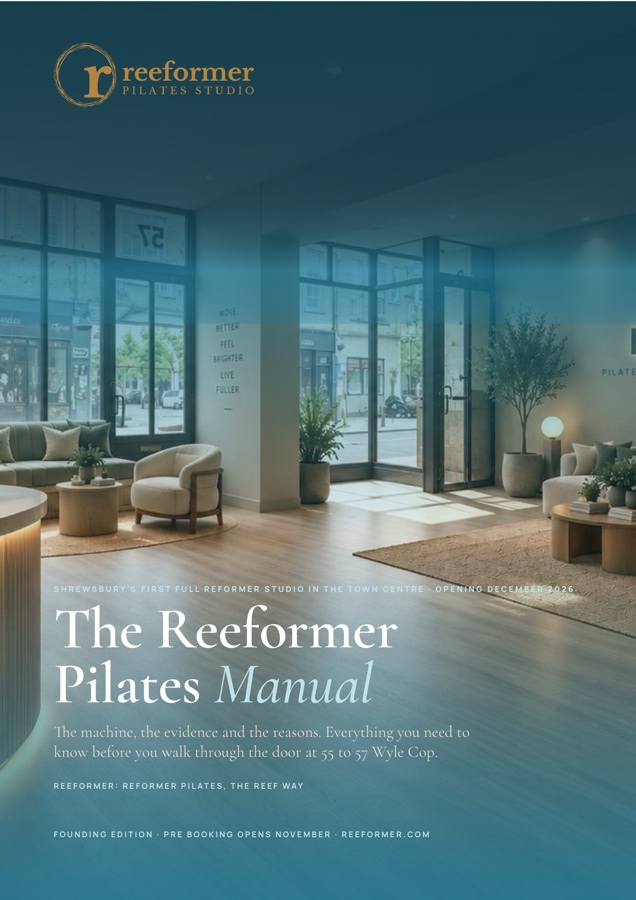
A free 42-page guide: the machine taken apart, the springs explained, your first 50 minutes minute by minute, every common worry answered, and every statistic sourced at the back. It arrives by email straight away and costs nothing.