
Education

How often should you
do reformer Pilates?

The honest answer is “more often than you currently do, less often than the internet says”. Here is what each frequency actually gets you.

Reef Wellness Studio · Wyle Cop, Shrewsbury

This is the question people ask after their third class, once the novelty has worn off and they are trying to work out where this fits in a real week. Here is a straight answer.

Once a week

Enough to stay familiar with the machine and to keep a habit alive. You will get better at the exercises, you will notice your posture more, and you will feel the day after for a while.

What once a week will not do, on its own, is transform how strong you are. It is maintenance plus slow progress, and there is nothing wrong with that — a sustainable once a week for two years beats an ambitious four times a week for three weeks, every single time.

Twice a week

This is the frequency we would aim for, and the one we have built the memberships around. Twice a week is enough that you stop re-learning the exercises each time, which makes the sessions themselves more productive.

It is also the point at which the habit stops needing a decision every week.

Three or more

Appropriate if reformer Pilates is your main form of training, or if you are working towards something specific. At this frequency it is worth varying what you do — a harder class, a gentler class, and a guided independent session where you work on something at your own pace, for instance.

Three or more sessions of the same intense class every week is how people get stale and sore rather than strong.

Alongside running or lifting

One or two reformer sessions a week is a sensible addition to almost any other training, because it is low impact and it works things that barbells and roads tend to neglect: rotational control, single-side balance, deep stabilisers, and range of movement under load.

Practical scheduling: put reformer on a day after a hard session rather than before one, and do not put it the day before a race or a heavy lift, at least until you know how your body responds.

How long until you notice something

In our experience the machine stops feeling strange around the third session. Noticeable changes in how you move usually take longer — think weeks rather than days, at a consistent two sessions a week.

The variable that matters is not how many sessions you book. It is how many you attend, for how many months.

We are deliberately not putting a number of weeks on outcomes here. Individual results depend on what you did before, what else you do, your age, your sleep and a dozen other things nobody selling you a class can control.

Building the week

At reef you can mix instructor-led classes with guided independent sessions, which makes two or three a week considerably easier to schedule around a real life. Prices and memberships here.
Questions

While we are on the subject

How often should you do reformer Pilates?
Once a week maintains familiarity and builds slowly. Twice a week is the frequency we would aim for. Three or more suits people using it as their main form of training, ideally varied in intensity.
Is reformer Pilates every day too much?
For most people, yes — daily sessions of the same intensity tend to produce fatigue rather than progress. If you train that often, vary the intensity and the format.
How long before I see results from reformer Pilates?
In our view the machine stops feeling strange around the third session. Changes in how you move take weeks of consistent practice, and depend on many factors nobody can promise.
Can I do reformer Pilates alongside running or weight training?
Yes. One or two sessions a week complements both. Schedule it after hard sessions rather than immediately before them.
How often should I do Reformer Pilates?
The NHS recommends muscle-strengthening work on at least two days a week, and names Pilates as one way to do it. Two Reformer sessions a week covers that on their own.
Is Reformer Pilates better than the gym?
It is different work rather than better work. A gym loads a muscle; a Reformer makes your whole body stabilise while it works, because the bed is moving under you. Plenty of people who lift heavy come out of a first Reformer class shaking.
Will I ache afterwards?
Usually less than you expect after the first class and more after the third, and it tends to sit in the neck and shoulders if you tensed. Tell your instructor and they will change it.
Is Reformer Pilates suitable for complete beginners?
Yes, and most people in any class started as one. A Reformer is adjustable, so the same exercise can be made easier or harder in seconds. Start with an instructor-led class, tell them it is your first time, and they will set your springs for you.
Can I do Reformer Pilates on my own, without a class?
Yes. You book a machine rather than a class time, pick from more than 800 guided sessions on the screen at the foot of your bed, and the audio plays in your own headphones. That is the point of the planned 7am to 10pm window: you come when your day allows.
What are the opening hours?
We plan to open 7am to 10pm, every day of the week. Those hours are confirmed when the building is finished.
What is Reformer Pilates?
A padded bed that slides on rails, held by springs, with a footbar at one end and straps at the other. You push the carriage away and control it back, so your muscles work in both directions with no momentum to hide behind.
What is the Reformer Pilates Manual?
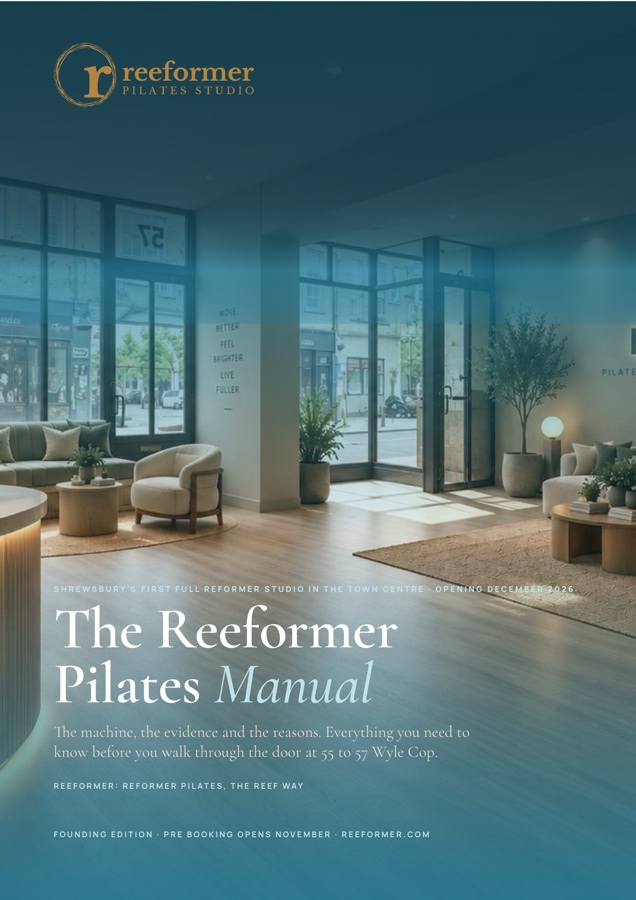
A free 42-page guide: the machine taken apart, the springs explained, your first 50 minutes minute by minute, every common worry answered, and every statistic sourced at the back. It arrives by email straight away and costs nothing.

Wyle Cop, Shrewsbury

Be first through the door.

Free Reformer Pilates Manual, and the opening timetable before anybody else sees it.

Keep reading

Beginners quiz Free manual